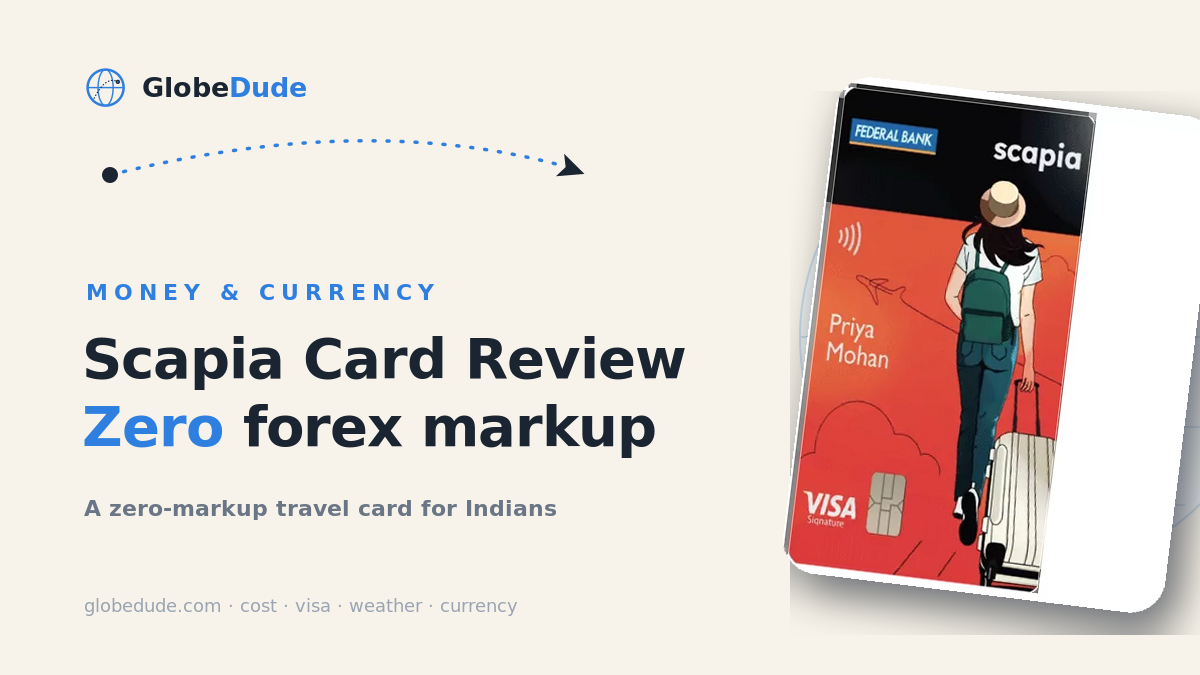
Short answer: Most Indian cards quietly add 2 to 3.5% forex markup plus fees on every overseas spend. The Scapia credit card charges zero forex markup and adds travel rewards, which makes it one of the most travel-friendly cards for Indians in 2026. Terms change, so always confirm the latest before applying.
If you travel abroad from India, the biggest silent cost is not flights or hotels. It is the forex markup baked into almost every card swipe and ATM withdrawal overseas. This guide breaks down that cost, how the Scapia card removes it, and whether it is worth it for you.
Heads up: this post contains an affiliate referral link. GlobeDude may earn a reward if you apply through it, at no extra cost to you. This is general information, not financial advice, so check Scapia’s current terms and pick what suits you.
The hidden cost: forex markup
When you spend on a normal Indian card abroad, the bank typically adds a forex markup of around 2 to 3.5% on top of the exchange rate, and often ATM and conversion fees on top. On a 2,00,000 rupee trip, that is roughly 4,000 to 7,000 rupees lost to fees alone, before you have bought a single thing you will remember.
That is money that could have been another two nights of hotels. The fix is a card built for travel.
How the Scapia card helps
As per Scapia’s current offering, the card is designed around international travel:
- Zero forex markup on international spends, so you pay close to the real rate.
- Rewards on spends (Scapia coins) that you can put towards travel bookings.
- Airport lounge access for a smoother departure, subject to conditions.
- No joining or annual fee historically, though you should confirm the latest terms.
Put simply, the markup you would lose on a regular card is roughly what you keep with a zero-markup card. Over a few international trips, that adds up fast.
Travel without the forex tax
Apply for the Scapia card and keep the markup most cards quietly take.
See what your rupees are worth abroad
Before you spend, it helps to know the real value of your money. Here is what 50,000 rupees is worth in popular destinations, at today’s live rate. With zero forex markup, you keep more of this.
Who it is best for
Scapia makes the most sense if you travel internationally at least once or twice a year, spend a fair amount on cards abroad, and want lounge access and travel rewards without an annual fee. If you rarely travel overseas, a zero-markup card matters less, so choose what fits your actual usage.
How to apply
Applying is a quick online process. Use the button above or this referral link, complete the application, and follow Scapia’s steps. Approval and eligibility are decided by Scapia and its banking partner.
A real example: what you save on one trip
Say you take a 10-day trip to Thailand and spend 1,50,000 rupees on the card across hotels, food, tours and shopping. On a typical Indian card with a 3.5% forex markup, that is roughly 5,250 rupees lost to markup alone, before ATM fees. On a zero-markup card like Scapia, that markup is close to nothing. Over two or three international trips a year, the difference easily runs into tens of thousands of rupees, which is a flight or several nights of hotels you get to keep.
Scapia vs a regular Indian card
- Forex markup: around 2 to 3.5% on most cards, versus zero on Scapia (as per current terms).
- Rewards on travel spends: often limited or capped, versus Scapia coins you can put back into travel.
- Lounge access: usually only on premium cards with high fees, versus included with Scapia subject to conditions.
- Annual fee: commonly charged, versus no joining or annual fee on Scapia historically.
Always confirm the latest terms, since card benefits and fees do change over time.
How to get the most from the card
- Use it for all overseas spends so every payment skips the forex markup.
- Prefer card payments over cash abroad to capture rewards and avoid poor exchange counters.
- Withdraw cash smartly. Check ATM and withdrawal terms, as those can differ from spends.
- Redeem Scapia coins for travel to get the most value out of your rewards.
- Pay your bill in full and on time to avoid interest, which cancels out any savings.
Things to keep in mind
A zero-forex card is only worth it if you travel abroad or shop internationally at least occasionally. Approval depends on eligibility set by Scapia and its banking partner, and like any credit card, it only helps your finances if you clear the balance in full each month. Treat the rewards and lounge access as a bonus, not a reason to overspend. This is general information, not financial advice, so pick the card that fits your real habits.
Frequently asked questions
How much can I save with a zero-forex-markup card?
You save the markup you would otherwise pay, usually 2 to 3.5% of every overseas spend, plus some ATM and conversion fees. On a 1,50,000 rupee trip that is roughly 3,000 to 5,250 rupees per trip.
Is Scapia a credit card or a debit card?
Scapia is a co-branded credit card issued with a banking partner (Federal Bank). Confirm the current issuer and product details on Scapia’s site.
Does Scapia offer airport lounge access?
Yes, Scapia has historically included airport lounge access subject to conditions such as minimum spends. Check the latest terms for the exact requirement.
Who can apply for the Scapia card?
It is available to eligible residents of India, with approval decided by Scapia and its banking partner based on their criteria.
What is forex markup on a card?
Forex markup is an extra fee, usually 2 to 3.5%, that most banks add on top of the exchange rate for every international transaction. A zero-markup card removes this fee.
Does the Scapia card really have zero forex markup?
As per Scapia’s current terms, yes, it advertises zero forex markup on international spends. Always confirm the latest terms on Scapia’s site before applying.
Is there an annual fee?
Scapia has historically offered the card with no joining or annual fee, but fees and benefits can change, so check the current details.
Who should get a zero-forex-markup card?
Anyone who travels abroad even once or twice a year and spends on cards while overseas will usually save more than enough to make a zero-markup card worthwhile.
This article contains an affiliate referral link and GlobeDude may earn a reward if you apply through it, at no extra cost to you. It is general information, not financial advice. Card terms, fees and benefits are set by Scapia and its banking partner and can change, so confirm the current details before applying.
See where your money goes furthest in the Money guide, or check live rates in the Explorer.
Keep reading on GlobeDude
Explore by topic: Best Time to Travel, Cost of Living, Visa Guides, Money & Currency. Or open the Explorer.